
Ferguson, Thomas Tapley Helenus (sold)

Thomas Tapley Helenus Ferguson (January 18, 1871 - June 20, 1946) was a Dutch surveyor and inventor. Born in Aruba, Ferguson arrived in China in the late 1800s and lived in Shanghai. He created two known maps, one entitled Map of the Waterways Near Shanghai and the other Map of the Country Round Soochow, for which he used a device of his own invention, which he called a Hodograph. Ferguson published a book in 1904 entitled Automatic Surveying Instruments and their Practical Uses on Land and Water in which he introduced his Hodograph (a device used for 'self-registering of courses and distances on water'), Cyclograph ('an automatic route-tracer for vehicles'), and Pedograph (an automatic route-tracer for pedestrians'). Ferguson applied for a patent in the United States in 1902, but it is unclear if he ever tried to patent his other two inventions. Records show that Ferguson was married four times and fathered four children. Ferguson died on June 20, 1946 at Exmouth in the United Kingdom.
A rare map of the environs of Suzhou made with a new device invented to survey the region's network of canals, rivers, streams, and creeks.
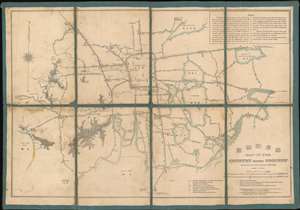
蘇境新測圖. Map of the Country round Soochow.
sold
- Digital Map Information
- Suitable for large format printing
- File Size: 17.96 MB
- File Type: ZIP / TIFF
- ICC color profile embedded
- Delivered instantly via download link
This is a 1901 Thomas Ferguson map of the garden city of Suzhou (Soochow), China and environs. Focusing on Suzhou's broad network of canals, the map encompasses the region from Lake Tai (Tai-Hu) to 'Soochow Creek' and from Yangcheng Lake (Yang-Sêng-Si-Wu) to the Grand Canal and 'Ng-Kong. The map serves the dual purpose of expanding military intelligence in the Yangtze Valley, and highlighting the usefulness of Ferguson's invention, the 'hodograph.' Ferguson used the hodograph to 'automatically' survey the canals, creeks, rivers, and other waterways in the region and then converted that data into his map. Arrows indicate the direction of some of the canals, which likely means that others supported two-way traffic. Suzhou's canals have always played a critical role in the local economy and even today are a major attraction for tourism. The Suzhou section of The Grand Canal passes through ten city gates and is traversed by more than twenty stone bridges. (more details)