
Murray, John (sold)
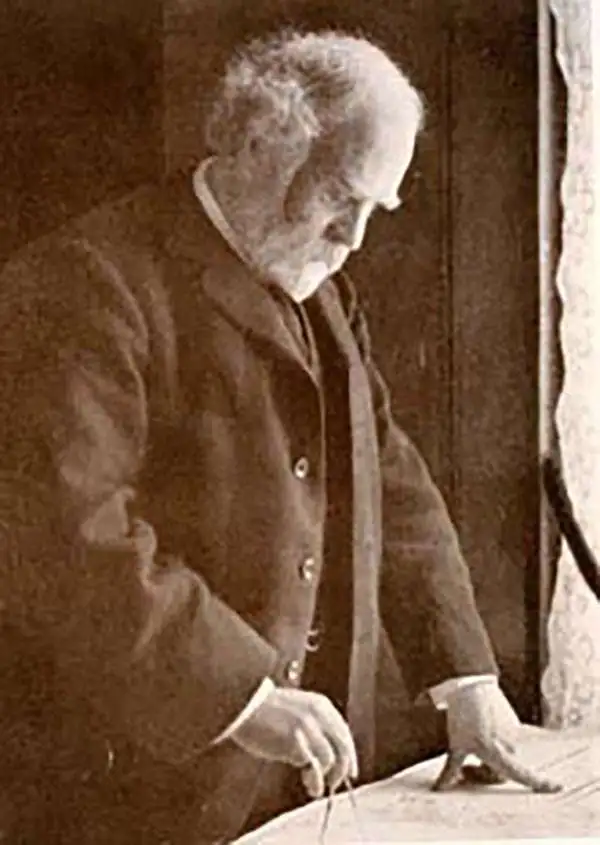
John Murray (March 3, 1841 - March 16, 1914), considered the father of modern oceanography, was a British oceanographer, limnologist, and marine biologist. Born at Cobourg, Canada West, Murray attended school in London, Ontario, and later Cobourg College. He returned to Scotland in 1858 (his parents had emigrated from Scotland to Canada around 1834) to continue his education at Stirling High School and live with his grandfather. He enrolled at the University of Edinburgh in 1864 with the intention of studying medicine, but he did not finish his studies and did not graduate. Instead, he joined the crew of a whaling ship, the Jan Mayen, as the ship's surgeon and spent the seven-month voyage collecting marine specimens and recording data on ocean currents, ice movements, and the weather. He returned to Edinburgh later that year and reenrolled at the University to study geology, graduating in 1872. That same year, Murray joined the Challenger Expedition as a naturalist and spent the four-year voyage assisting in the research of the oceans. After the expedition's return, Murray was made a Chief Assistant at the Challenger offices and he managed and organized the expedition's collections. He became Director of the office in 1882 after the death of the expedition's chief scientist, Charles Wyville Thomson, and published The Report on the Scientific Results of the Voyage of HMS Challenger in 1896, which consisted of more than fifty volumes. Murray established the Marine Laboratory at Granton, Edinburgh, in 1884, the first laboratory of its kind in the United Kingdom. The lab was moved to Millport in 1894 and became the University Marine Biological Station, Millport, which is known today as the Scottish Association for Marine Science. Murray proposed an oceanographic expedition to the North Atlantic in 1909 and agreed to pay all the expenses. The Norwegian government, in turn, lent him the research ship Michael Sars and its scientific crew. The expedition was joined by Norwegian marine biologist Johan Hjort and set out in April 1910. It spent four months taking physical and biological observations at all depths between Europe and North America, and Murray and Hjort published The Depths of the Ocean with their findings in 1912, a book that became a classic for marine naturalists and oceanographers. Murray was killed on March 16, 1914, when his car overturned ten miles west of his home.
Murray provides scientific proof of the long believed in southern continent - Antarctica!
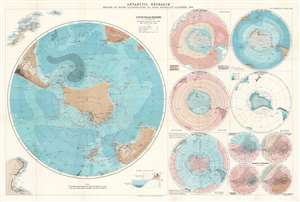
Antarctic Research. Series of Maps Illustrating Dr. John Murray's Address, 1893.
sold
- Digital Map Information
- Suitable for large format printing
- File Size: 30.55 MB
- File Type: ZIP / TIFF
- ICC color profile embedded
- Delivered instantly via download link
This is an 1894 John George Bartholomew map of Antarctica created to accompany Dr. John Murray's address to the Royal Geographical Society (RGS) in 1893. Consisting of one large map of the south polar regions and several smaller ones on one sheet, each map center's on Murray's proposed outline of Antarctica as he believed it existed following his experience as part of the Challenger Expedition. Over the course of his presentation to the RGS, Murray stated that, because of the presence of certain rocks dredged from the ocean floor in the south polar region, he was capable of scientifically confirming the long-hypothesized existence of an Antarctic continent. He even went so far as to state that he believed the continent to be larger than Australia! Each of the maps present on this sheet bears an illustration of Murray's proposed outline of Antarctica. A large portion of the data presented in these maps came directly from the archives of the Challenger Expedition, making a large portion of it new information to the public. (more details)