
Smith, Samuel Crawford (sold)

Samuel Crawford Smith (August 28, 1838 - August 8, 1916) was an American civil engineer and draftsman. Born in Newark, New Jersey to English and Welsh immigrants, Smith served as a captain and then a brevet colonel in the first independent engineering corps of Pennsylvania during the American Civil War. He served with distinction and was stationed on the Potomac with headquarters at Harper's Ferry and on the Monongehela at Grafton and Fairmount. While at Harper's Ferry, just prior to the Battle of Gettysburg, Smith built a pontoon bridge in eight hours that allowed Union General Meade's army to cross the river. He also built and maintained a bridge at Fairmount, Virginia, which protected that city from a Confederate attack. After the war, Smith continued his career in civil engineering and was connected with the Survey Bureau of the City of Philadelphia for thirty years. He also worked as a surveyor for the city of Harrisburg and served as the chief of the Bureau of Statistics of the State of Pennsylvania for a number of years. He also played a prominent role in the early days of railroading in Pennsylvania. In September 1882, Smith was appointed draughtsman in the Department of Internal Affairs in Harrisburg. He also served as Superintendent and Chief Engineer of the Schuylkill Navigation Company for many years. Notably, he lost a contest seeing who could write 'Grand Union Baking Powder. Eight tickets with each pound', after his card was disqualified for being printed instead of handwritten. He managed to fit the sentence on the card 558 times. The contest winner wrote managed to write that sentence on their postcard 271 times. Smith died in Philadelphia on August 8, 1916, of a cerebral hemorrhage. He married Clarinda Boydston, known as Clara, at some point after the American Civil War with whom he had had three sons and a daughter.
Celebrates the centennial of the signing of the Declaration of Independence.
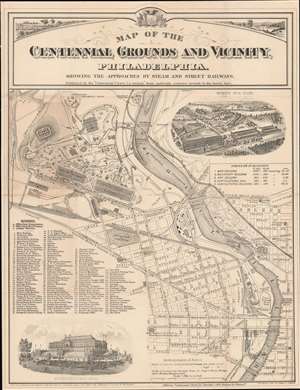
Map of the Centennial Grounds and Vicinity, Philadelphia. Showing the Approaches by Steam and Street Railways.
sold
- Digital Map Information
- Suitable for large format printing
- Full resolution TIFF file
- ICC color profile embedded
- Delivered instantly via download link
This is an 1875 Samuel Crawford Smith map of the Centennial Exhibition in Philadelphia, Pennsylvania. The Exhibition's main buildings, the Main Exhibition Building, the Machinery Building, Horticultural Hall, the Art Gallery, and the Agricultural Building, are all illustrated and labeled. One hundred thirty-five other buildings across the fairgrounds are numerically labeled and correspond with an index situated in the lower left. Pathways through the fairgrounds are illustrated, some named, including Belmont Avenue, Fountain Avenue, and River Road. Downtown Philadelphia occupies the lower right, with its street grid clearly illustrated. Numerous railroads, such as the Pennsylvania Railroad, traverse the city and serve the fairgrounds. The Schuylkill River cuts a diagonal path through the city and creates the fair's eastern border. A steamboat landing was explicitly built for the Exhibition and directly connected the river and the fairgrounds. (more details)