
Zettl, Ludwig (sold)
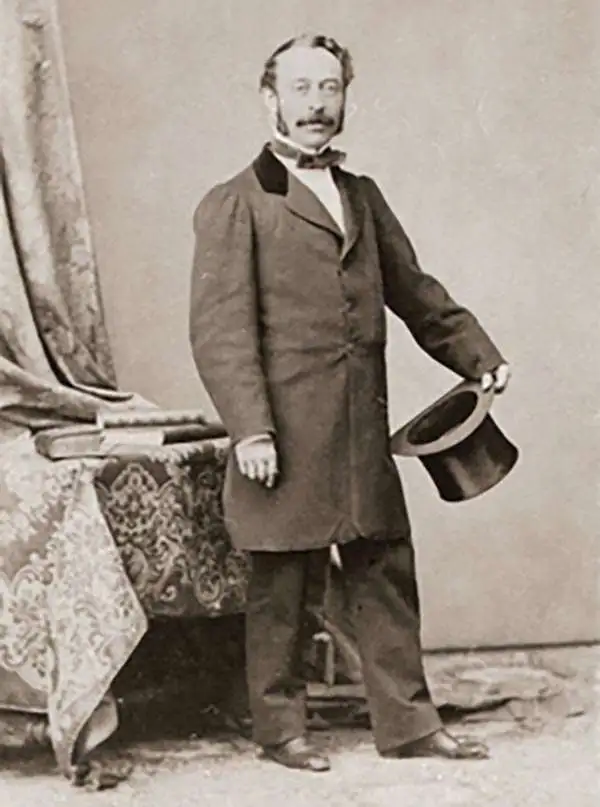
Ludwig Zettl (May 5, 1821 - April 14, 1891) was a Bohemian-Austrian architect and civil engineer active in the second half of the 19th century. Zettl was born in the Czech town of Poděbrady. He studied first at the Prague Polytechnikum, then, from 1843 - 1844, at the Vienna Polytechnische Institut. Afterward, he worked as an intern at the Vienna Staatsbaudepartement while studying architecture at the Akademie der Bildenden Künste Wien (Vienna Academy of Fine Arts). The internship proved valuable, as Zettl's connections yielded design contracts from 1850 onwards for state hospitals and prisons - the work for which he is most famous. By 1859, he was an Ingenieur I. Klasse (First Class Imperial Engineer). From 1859 to 1865, he was a member of the Vienna Building Commission and, as a technical representative of the ministry, a member of the City Expansion Commission. His plans greatly influenced the construction of the Wiener Ringstrassenzone, one of the world's most spectacular boulevards. His work earned him numerous accolades, including the Franz-Joseph-Orden (Franz-Joseph Order), the Ordens der Eisernen Krone (Order of the Iron Crown), and in 1883, a knighthood.
The Ringstrasse - planning the democratization of Vienna.
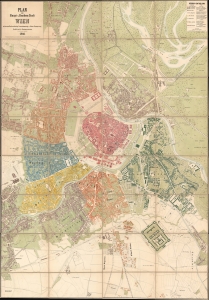
Plan der Haupt-u. Residenz Stadt Wein mit der neuen Bezirkseintheilung, Strassenbenennung under Häuser-Nummerirung.
sold
- Digital Map Information
- Suitable for large format printing
- File Size: 283.83 MB
- File Type: ZIP / TIFF
- ICC color profile embedded
- Delivered instantly via download link
A rare and significant 1866 official planning map of Vienna (Wein) drawn by Ludwig Zettle, one of the civil engineers working on the development of the Ringstrasse and the expansion of the city beyond its historic walls. The work represents a transitional moment, both for Vienna and for the Austrian Empire as a whole. One year after this map was issued, the Hapsburg Empire was reorganized as the constitutional Austro-Hungarian Monarchy. Likewise, the deconstruction of Vienna's walls, the expansion of the city, and the integration of the existing suburbs are evidence of an ongoing democratization of Austria and Europe in general. (more details)