
Bode, Johann Elert (sold)

Johann Elert Bode (January 19, 1747 - November 23, 1826), or Joannis Elerti Bode, was a German astronomer active in Berlin during the late 18th and early 20th centuries. Bode was born in Hamburg and exhibited an early aptitude for mathematics, which brought him to the attention of Johann Georg Busch, whose library he was given access to. His interest turned towards astronomy early on and in 1766 he published his first work, a treatise on eclipses. He later published more treatises and issued an annual periodical called Astronomisches Jahrbuch, which enjoyed a 51 year run. In 1786 he became the director of the Berlin Observatory. During his tenure in this position he calculated the trajectory of Uranus, named the planet, and discovered the Galaxy M81, more commonly known as Bode's Galaxy. Bode is best known for his popularization of Bode’s law, or the Titius-Bode rule, an empirical mathematical expression for the relative mean distances between the Sun and its planets. However, in cartographic circles is best he is more admired for his 1801 publication of the Uranographia sive Astrorum Descriptio, a gigantic elephant folio atlas of the stars and the climax of an epoch of artistic representation of the constellations. Bode also published a smaller star atlas, the Vorstellung der Gestirne. Bode retired from professional life in 1825 and died in Berlin on year later.
The first, largest, and finest star maps of the 19th century.
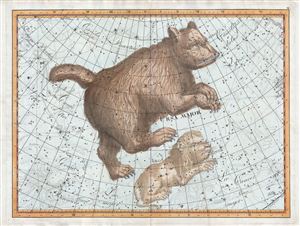
Ursa Major.
sold
- Digital Map Information
- Suitable for large format printing
- Full resolution TIFF file
- ICC color profile embedded
- Delivered instantly via download link
A rare and extraordinary 1801 Johann Elbert Bode elephant folio celestial, constellation, or star map of Ursa Major (the Great Bear or Big Dipper) and Leo Minor. Considered the largest and most dramatic celestial maps of their era, possibly ever published, Bode's ... (more details)
The first, largest, and finest star maps of the 19th century.
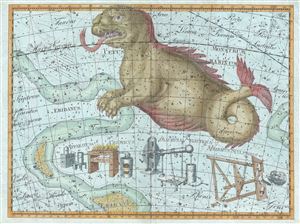
[Cetus Monstrum Marinum]
sold
- Digital Map Information
- Suitable for large format printing
- DPI: 300
- File Size: 33.29 MB
- File Type: ZIP / TIFF
- ICC color profile embedded
- Delivered instantly via download link
A rare and extraordinary 1801 Johann Elbert Bode elephant folio celestial, constellation, or star map of Cetus (the Sea Monster) or as it is more commonly known, the Whale. Cetus was originally been associated with a whale, which would have had mythic status ... (more details)
The first, largest, and finest star maps of the 19th century.
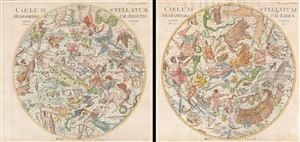
Coelum Stellatum Hemisphaerium Librae / Coelum Stellatum Hemisphaerium Arietis.
sold
- Digital Map Information
- Suitable for large format printing
- DPI: 300
- File Size: 51.59 MB
- File Type: ZIP / TIFF
- ICC color profile embedded
- Delivered instantly via download link
A rare and extraordinary pair of elephant folio celestial hemisphere charts or star maps issued in 1801 by Johann Elert Bode. Considered the largest and most dramatic celestial map of its era, possibly ever published, these gigantic star charts detail ... (more details)
The Big Dipper.
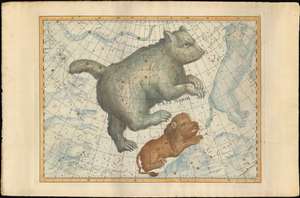
[Ursa Major].
sold
- Digital Map Information
- Suitable for large format printing
- Full resolution TIFF file
- ICC color profile embedded
- Delivered instantly via download link
An exceptional example of the 1801 Johann Elbert Bode elephant folio celestial, constellation, or star map of Ursa Major (the Great Bear or Big Dipper) and Leo Minor. Considered the largest and most dramatic celestial maps of their era, possibly ever published, Bode's gigantic star charts detail thousands of stars, nebulae, and clusters. Constellations are dramatically represented in pictorial form, as was the convention of the previous century. Many of the newly discovered nebulae, double stars, star clusters discovered by European astronomers in the late 18th century, such as Lacaille, Lalande, Messier, and Herschel, are identified. Bode presents this map on a conic geocentric projection in which most constellations are seen as from Earth. The current example is spectacularly colored gold highlighting of important stars. (more details)