
Boitard, Louis-Philippe (sold)

Louis-Philippe Boitard (fl. 1733 - 1758) was a French-born engraver active in London during the middle part of the 18th century. He was born in Paris and relocated to London with his father François Boitard (1670 – 1719), a baroque painter, as a young man. Boitard mastered engraving under the tutelage of Raymond Lafage. His most notable work is the compilation and engraving of 41 plates in total for Joseph Spence's Polymetis. At the time of his death he was based in England.
Oldest known depiction of the celestial spheres - from the Farnese Atlas.
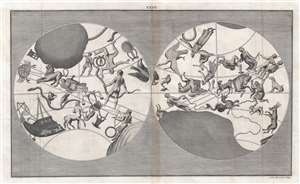
XXIV.
sold
- Digital Map Information
- Suitable for large format printing
- DPI: 300
- File Size: 10.31 MB
- File Type: ZIP / TIFF
- ICC color profile embedded
- Delivered instantly via download link
A highly unusual 1747 illustration of the celestial globe on the 2nd-century AD Roman sculpture known as the Farnese Atlas. It was drawn by Louis-Philippe Boitard and printed for Joseph Spence's Polymetis. This double hemisphere celestial is unique in that the constellations, including the Zodiac, are beautifully engraved in figural form, but the map does not depict any actual stars. The lines of the meridian and the Zodiac are however present. There are two, blacked out zones, reflecting areas covered by the head, and hands of the sculpture. (more details)
The Fall of French Power in America on the Eve of the Seven Years' War.
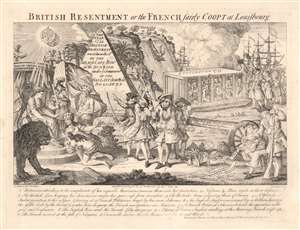
British Resentment, or, the French fairly Coopt at Louisbourg.
sold
- Digital Map Information
- Suitable for large format printing
- Full resolution TIFF file
- ICC color profile embedded
- Delivered instantly via download link
This is an English 1755 satirical cartoon celebrating and encouraging the British to take up arms against France in North America, and lampooning France' waning power during the buildup of what would become the French and Indian War (1754 - 1763). The 'resentment of the British', as in the title, refers to British annoyance at French interference in their sphere of influence in the Americas, and French attacks on British Colonists; the Scottish motto above Britannia's throne (Nemo me impune lacessit, no one attacks me with impunity) reiterates the justification for war. But while referencing many points of conflict between the two powers throughout the prospective theatre of war, this work is most specifically in reference to the action of June 8, 1755 - a controversial British naval victory over the French which contributed to the 1756 declaration of war. Hostilities between French and British colonial forces were already underway in 1754 over control of the Ohio River Valley and Nova Scotia, and both Britain and France were rushing troops to reinforce their respective colonial interests. The British Navy sent a fleet (under the command of Vice Admiral Edward Boscawen) to the Gulf of St. Lawrence to intercept French ships en route to Quebec City, but for the most part the French eluded the blockade, landing ships at Louisbourg in Nova Scotia. (more details)