
Deutsch, Hans Rudolf Manuel (sold)

Hans Rudolf Manuel Deutsch (1525–1571) was a Swiss artist and woodcutter. His work appeared in Agricola's De re metallica and for Sebastian Münster's Cosmographia. Deutsch's father, Niklaus Manuel Deutsch (the Elder) and his brother Niklaus were also artists.
Munster's Monsters!
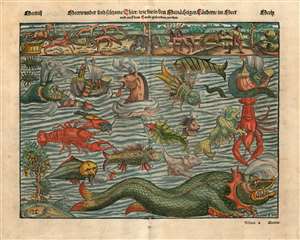
Meerwunder und seltzame Their/ wie die in den Mitnachigen Landern im Meer.
sold
- Digital Map Information
- Suitable for large format printing
- DPI: 600
- File Size: 22.62 MB
- File Type: ZIP / TIFF
- ICC color profile embedded
- Delivered instantly via download link
Often euphemistically referred to as Munster's Monsters, this is Sebastian Munster's bestiary of sea serpents and other terrifying monsters, some fictional, some real, that was included in the 1545 Cosmographia. Most of the beasts here are derived from a 1539 map of Scandinavia drawn by Olaus Magnus. Although Munster's Monsters may initially seam fabulous and scary, many are based upon or outright depictions the factual creatures that Scandinavian sailors and whalemen actually encountered. This woodcut was composed by the Swiss artist Hans Rudolf Manuel Deutsch, who produced many of Munster's woodcuts. The actual Formschneider is unknown beyond his initials, M-F, which appear along with 'Deutsch's HR-MD.'
Among the more recognizable beasts are various forms of whales with obvious blowholes, at least two enormous lobsters, a sea serpent (probably an oarfish), the whale fish (white fish at center, an Orca), and something that might very well be a walrus. Of course, there are fictional sea monsters too, including a pig faced sea beast, apparently seen by sailors in 1537, and the Sea Buffalo, something that looks like a cross between a bull and a fish.
Although much is made of Munster's sea creatures, it should be noted that his map also illustrates land based fauna, most of which is far more realistic. These include reindeer, beavers, sables, bears, a wolverine, snakes, and what might be some sort of large cat. In the lower left, there is a tree populated by 'duckbirds,' a curious kind of avian that Munster claims 'grows on trees' but which, in his lifetime, had not been seen for some 400 years.
Although not properly a map, Munster included this catalog of beasts in his Cosmographia to illustrate the natural world. Today we might look at a book like the Cosmographia and consider it an atlas for its many maps, but the work itself is more accurately an attempt to describe, as the name suggests, the entire cosmos. It included descriptions of flora, fauna, geological and astronomical observations, historical notes, and cultural (some might even say anthropological) commentary. (more details)
Among the more recognizable beasts are various forms of whales with obvious blowholes, at least two enormous lobsters, a sea serpent (probably an oarfish), the whale fish (white fish at center, an Orca), and something that might very well be a walrus. Of course, there are fictional sea monsters too, including a pig faced sea beast, apparently seen by sailors in 1537, and the Sea Buffalo, something that looks like a cross between a bull and a fish.
Although much is made of Munster's sea creatures, it should be noted that his map also illustrates land based fauna, most of which is far more realistic. These include reindeer, beavers, sables, bears, a wolverine, snakes, and what might be some sort of large cat. In the lower left, there is a tree populated by 'duckbirds,' a curious kind of avian that Munster claims 'grows on trees' but which, in his lifetime, had not been seen for some 400 years.
Although not properly a map, Munster included this catalog of beasts in his Cosmographia to illustrate the natural world. Today we might look at a book like the Cosmographia and consider it an atlas for its many maps, but the work itself is more accurately an attempt to describe, as the name suggests, the entire cosmos. It included descriptions of flora, fauna, geological and astronomical observations, historical notes, and cultural (some might even say anthropological) commentary. (more details)
Sebastian Münster's Home City.
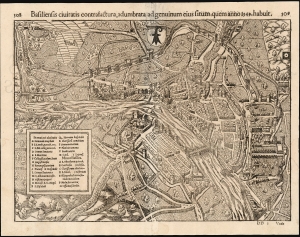
Basiliensis civitatis contrafactura, adumbrata ad genuinum eius situm, quem anno 1549, habuit.
sold
- Digital Map Information
- Suitable for large format printing
- Full resolution TIFF file
- ICC color profile embedded
- Delivered instantly via download link
Sebastian Münster's lively and remarkably accurate woodcut bird's-eye view of Basel, Switzerland's old town as it stood in 1549, is the earliest acquirable map of that city. It is preceded only by the view appearing in the 1493 Nuremberg Chronicle. Münster's work is particularly significant, as it is a representation of the mapmaker's home city. (more details)
An Early Woodcut Map of the Holy Land.
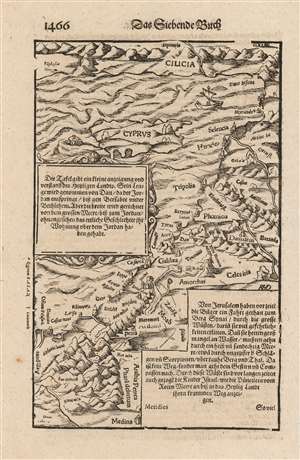
[Woodcut map of the Eastern Mediterranean Sea, Cyprus and the Holy Land.
sold
- Digital Map Information
- Suitable for large format printing
- DPI: 600
- File Size: 14.68 MB
- File Type: ZIP / TIFF
- ICC color profile embedded
- Delivered instantly via download link
This is a Sebastian Münster's woodcut map of the Holy Land and Cyprus, from a German edition of his masterwork, Cosmographia. The map contextualizes the Holy Land with the whole Levant, from Egypt to the coast of Asia Minor. The map includes the track of the Israelites from Egypt to Canaan. The Arabian city of Medina appears at the southernmost extent of the map.
The image first appeared in the expanded 1550 editions of Munster's Cosmographia, a work which for more than half a century provided the European literate layperson their best source of information about the world. The map's detail may have been largely drawn from Waldseemüller's Ptolemaic map of the Holy Land and the Fertile Crescent but focusing specifically on the Biblical lands and narrowing the selection of place names to reflect the Biblical era. It is interesting the Münster retains the northern orientation of the Ptolemaic Quarta Asia Tabula rather than adopting the eastern orientation of the medieval Sanuto-Vesconte, which would dominate the mapping of these lands well into the eighteenth century. That orientation allows for the inclusion of the island of Cyprus, set amongst the waves of the Mediterranean Sea. There is also a sea monster and a sailboat. (more details)
The image first appeared in the expanded 1550 editions of Munster's Cosmographia, a work which for more than half a century provided the European literate layperson their best source of information about the world. The map's detail may have been largely drawn from Waldseemüller's Ptolemaic map of the Holy Land and the Fertile Crescent but focusing specifically on the Biblical lands and narrowing the selection of place names to reflect the Biblical era. It is interesting the Münster retains the northern orientation of the Ptolemaic Quarta Asia Tabula rather than adopting the eastern orientation of the medieval Sanuto-Vesconte, which would dominate the mapping of these lands well into the eighteenth century. That orientation allows for the inclusion of the island of Cyprus, set amongst the waves of the Mediterranean Sea. There is also a sea monster and a sailboat. (more details)
First edition of the earliest acquirable view Frankfurt an der Oder.
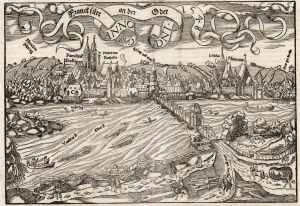
Frankfurt an der Oder Anno Dni. 1548 RMD.
sold
- Digital Map Information
- Suitable for large format printing
- DPI: 600
- File Size: 28.46 MB
- File Type: ZIP / TIFF
- ICC color profile embedded
- Delivered instantly via download link
This Sebastian Münster's lively 1550 view of Frankfurt an der Oder, in Germany near the border of Poland, one of the earliest acquirable printed images of that city. This example is of the first edition of Munster's Cosmographia in which it appeared, the much-expanded German edition of 1550. (more details)
Bestiary of fantastical northern monsters.
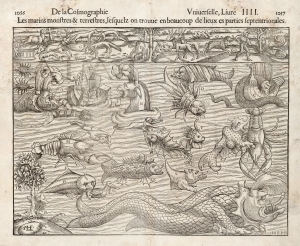
Les marins monstres et terrestres, lesquelz on trouve en beaucoup de lieux es parties septentrionales.
sold
- Digital Map Information
- Suitable for large format printing
- DPI: 600
- File Size: 31.37 MB
- File Type: ZIP / TIFF
- ICC color profile embedded
- Delivered instantly via download link
An attractive printing of what is often euphemistically referred to as Munster's Monsters, this is Sebastian Münster's bestiary of sea serpents and other astonishing monsters, some fictional, some real. The image first appeared in the expanded 1550 editions of Munster's Cosmographia, a work which for more than half a century provided the European literate layperson their best source of information about the world. Most of the beasts here are derived from a 1539 map of Scandinavia by Olaus Magnus. As fanciful as these creatures may appear, many depict factual creatures that Scandinavian sailors and whalemen occasionally encountered. Among the more recognizable beasts are various forms of whales with obvious blowholes, at least two enormous lobsters, a sea serpent (possibly an oarfish), the whale fish (white fish at center, an Orca), and something that might very well be a walrus. Of course, there are fictional sea monsters too, including a pig faced sea beast, apparently seen by sailors in 1537, and the Sea Buffalo, something that looks like a cross between a bull and a fish. (more details)
Bestiary of fantastical northern monsters.
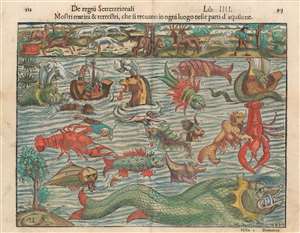
Mostri marini e terrestri, che si trouano in ogni luogo nelle parti d'aquilone.
sold
- Digital Map Information
- Suitable for large format printing
- Full resolution TIFF file
- ICC color profile embedded
- Delivered instantly via download link
Often euphemistically referred to as Munster's Monsters, this is Sebastian Münster's bestiary of sea serpents and other astonishing monsters, some fictional, some real. The image first appeared in the expanded 1550 editions of Munster's Cosmographia, a work which for more than half a century provided the European literate layperson their best source of information about the world. Most of the beasts here are derived from a 1539 map of Scandinavia by Olaus Magnus. As fanciful as these creatures may appear, many depict factual creatures that Scandinavian sailors and whalemen occasionally encountered. Among the more recognizable beasts are various forms of whales with obvious blowholes, at least two enormous lobsters, a sea serpent (possibly an oarfish), the whale fish (white fish at center, an Orca), and something that might very well be a walrus. Of course, there are fictional sea monsters too, including a pig faced sea beast, apparently seen by sailors in 1537, and the Sea Buffalo, something that looks like a cross between a bull and a fish. (more details)
Bestiary of fantastical northern monsters.
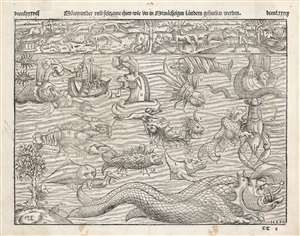
Mœrwunder und seltzame thier / wie die in den mitnåchtigen lándern gefunden werden.
sold
- Digital Map Information
- Suitable for large format printing
- Full resolution TIFF file
- ICC color profile embedded
- Delivered instantly via download link
An attractive 1558 printing of what is often euphemistically referred to as Munster's Monsters, this is Sebastian Münster's bestiary of sea serpents and other astonishing monsters, some fictional, some real. The image first appeared in the expanded 1550 editions of Munster's Cosmographia, a work which for more than half a century provided the European literate layperson their best source of information about the world. Most of the beasts here are derived from a 1539 map of Scandinavia by Olaus Magnus. As fanciful as these creatures may appear, many depict factual creatures that Scandinavian sailors and whalemen occasionally encountered. Among the more recognizable beasts are various forms of whales with obvious blowholes, at least two enormous lobsters, a sea serpent (possibly an oarfish), the whale fish (possibly an Orca), and something that might very well be a walrus. Of course, there are fictional sea monsters too, including a pig faced sea beast, apparently seen by sailors in 1537, and the Sea Buffalo, something that looks like a cross between a bull and a fish. (more details)
Bestiary of fantastical northern monsters.
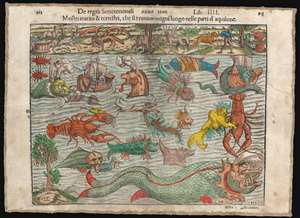
Mostri marini e terrestri, che si trouano in ogni luogo nelle parti d'aquilone.
sold
- Digital Map Information
- Suitable for large format printing
- Full resolution TIFF file
- ICC color profile embedded
- Delivered instantly via download link
Often euphemistically referred to as Munster's Monsters, this is Sebastian Münster's bestiary of sea serpents and other astonishing monsters, some fictional, some real. The image first appeared in the expanded 1550 editions of Munster's Cosmographia, a work which for more than half a century provided the European literate layperson their best source of information about the world. Most of the beasts here are derived from a 1539 map of Scandinavia by Olaus Magnus. As fanciful as these creatures may appear, many depict factual creatures that Scandinavian sailors and whalemen occasionally encountered. Among the more recognizable beasts are various forms of whales with obvious blowholes, at least two enormous lobsters, a sea serpent (possibly an oarfish), the whale fish (white fish at center, an Orca), and something that might very well be a walrus. Of course, there are fictional sea monsters too, including a pig faced sea beast, apparently seen by sailors in 1537, and the Sea Buffalo, something that looks like a cross between a bull and a fish. (more details)
Bestiary of fantastical northern monsters.
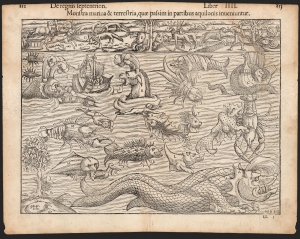
Monstra marina et terrestria, quae passim in partibus aquilonis inveniuntir.
sold
- Digital Map Information
- Suitable for large format printing
- DPI: 600
- File Size: 32.12 MB
- File Type: ZIP / TIFF
- ICC color profile embedded
- Delivered instantly via download link
An attractive printing of what is often euphemistically referred to as Munster's Monsters, this is Sebastian Münster's bestiary of sea serpents and other astonishing monsters, some fictional, some real. The image first appeared in the expanded 1550 editions of Munster's Cosmographia, a work which for more than half a century provided the European literate layperson their best source of information about the world. Most of the beasts here are derived from a 1539 map of Scandinavia by Olaus Magnus. As fanciful as these creatures may appear, many depict factual creatures that Scandinavian sailors and whalemen occasionally encountered. Among the more recognizable beasts are various forms of whales with obvious blowholes, at least two enormous lobsters, a sea serpent (possibly an oarfish), the whale fish (white fish at center, an Orca), and something that might very well be a walrus. A pelican (letter R) is recognizably depicted, and it is described on the verso including part of its scientific name (Onocrotalus.) Of course, there are fictional sea monsters too, including a pig faced sea beast, apparently seen by sailors in 1537, and the Sea Buffalo, something that looks like a cross between a bull and a fish. (more details)
Scarce Woodcut of Szczecin / Stettin.
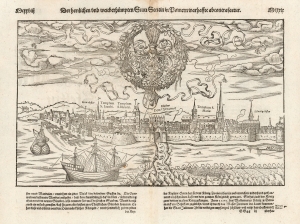
Der herzlichen und weitberhuempten Statt Stettin in Pomern warhaffte abcontrafactur.
sold
- Digital Map Information
- Suitable for large format printing
- DPI: 600
- File Size: 28.4 MB
- File Type: ZIP / TIFF
- ICC color profile embedded
- Delivered instantly via download link
This lively view of Szczecin, Poland is among the earliest acquirable printed images of that city, possibly the first. (more details)
Bestiary of fantastical northern monsters.
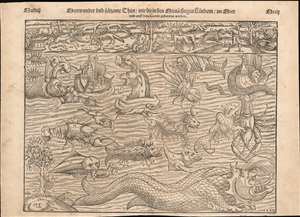
Meerwunder und seltzame Their/ wie die in den Mitnachtigen Landern im Meer.
sold
- Digital Map Information
- Suitable for large format printing
- Full resolution TIFF file
- ICC color profile embedded
- Delivered instantly via download link
Often euphemistically referred to as Munster's Monsters, this is Sebastian Munster's bestiary of sea serpents and other terrifying monsters, some fictional, some real, that was included in Munster's Cosmographia, which for more than half a century provided the European literate layperson their best source of information about the world away from their homes. Most of the beasts here are derived from a 1539 map of Scandinavia drawn by Olaus Magnus. Although Munster's Monsters may initially seem fabulous and scary, many are based upon or outright depictions of the factual creatures that Scandinavian sailors and whalemen actually encountered. This woodcut was composed by the Swiss artist Hans Rudolf Manuel Deutsch, who produced many of Munster's woodcuts. The actual Formschneider is unknown beyond his initials, M-F, which appear along with 'Deutsch's HR-MD.'
Among the more recognizable beasts are various forms of whales with obvious blowholes, at least two enormous lobsters, a sea serpent (probably an oarfish), the whale fish (white fish at center, an Orca), and something that might very well be a walrus. Of course, there are fictional sea monsters too, including a pig faced sea beast, apparently seen by sailors in 1537, and the Sea Buffalo, something that looks like a cross between a bull and a fish.
Although much is made of Munster's sea creatures, it should be noted that his map also illustrates land based fauna, most of which are far more realistic. These include reindeer, beavers, sables, bears, a wolverine, snakes, and what might be some sort of large cat. In the lower left, there is a tree populated by 'duckbirds,' a curious kind of avian that Munster claims 'grows on trees' but which, in his lifetime, had not been seen for some 400 years.
Although not properly a map, Munster included this catalog of beasts in his Cosmographia to illustrate the natural world. Today we might look at a book like the Cosmographia and consider it an atlas for its many maps, but the work itself is more accurately an attempt to describe, as the name suggests, the entire cosmos. It included descriptions of flora, fauna, geological and astronomical observations, historical notes, and cultural (some might even say anthropological) commentary. (more details)
Among the more recognizable beasts are various forms of whales with obvious blowholes, at least two enormous lobsters, a sea serpent (probably an oarfish), the whale fish (white fish at center, an Orca), and something that might very well be a walrus. Of course, there are fictional sea monsters too, including a pig faced sea beast, apparently seen by sailors in 1537, and the Sea Buffalo, something that looks like a cross between a bull and a fish.
Although much is made of Munster's sea creatures, it should be noted that his map also illustrates land based fauna, most of which are far more realistic. These include reindeer, beavers, sables, bears, a wolverine, snakes, and what might be some sort of large cat. In the lower left, there is a tree populated by 'duckbirds,' a curious kind of avian that Munster claims 'grows on trees' but which, in his lifetime, had not been seen for some 400 years.
Although not properly a map, Munster included this catalog of beasts in his Cosmographia to illustrate the natural world. Today we might look at a book like the Cosmographia and consider it an atlas for its many maps, but the work itself is more accurately an attempt to describe, as the name suggests, the entire cosmos. It included descriptions of flora, fauna, geological and astronomical observations, historical notes, and cultural (some might even say anthropological) commentary. (more details)
Bestiary of fantastical northern monsters.
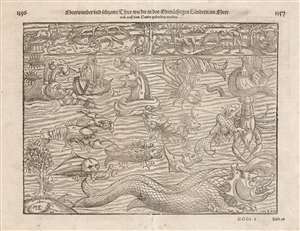
Meerwunder und seltzame Thier/ wie die in den Mitnåchtigen Låndern im Meer.
sold
- Digital Map Information
- Suitable for large format printing
- Full resolution TIFF file
- ICC color profile embedded
- Delivered instantly via download link
Often euphemistically referred to as Munster's Monsters, this is Sebastian Munster's bestiary of sea serpents and other terrifying monsters, some fictional, some real, that was included in Munster's Cosmographia, which for more than half a century provided the European literate layperson their best source of information about the world away from their homes. Most of the beasts here are derived from a 1539 map of Scandinavia drawn by Olaus Magnus. Although Munster's Monsters may initially seem fabulous and scary, many are based upon or outright depictions of the factual creatures that Scandinavian sailors and whalemen actually encountered. This woodcut was composed by the Swiss artist Hans Rudolf Manuel Deutsch, who produced many of Munster's woodcuts. The actual Formschneider is unknown beyond his initials, M-F, which appear along with Deutsch's 'HR-MD.'
Among the more recognizable beasts are various forms of whales with obvious blowholes, at least two enormous lobsters, a sea serpent (probably an oarfish), the whale fish (white fish at center, an Orca), and something that might very well be a walrus. Of course, there are fictional sea monsters too, including a pig faced sea beast, apparently seen by sailors in 1537, and the Sea Buffalo, something that looks like a cross between a bull and a fish.
Although much is made of Munster's sea creatures, it should be noted that his map also illustrates land based fauna, most of which are far more realistic. These include reindeer, beavers, sables, bears, a wolverine, snakes, and what might be some sort of large cat. In the lower left, there is a tree populated by 'duckbirds,' a curious kind of avian that Munster claims 'grows on trees' but which, in his lifetime, had not been seen for some 400 years.
Although not properly a map, Munster included this catalog of beasts in his Cosmographia to illustrate the natural world. Today we might look at a book like the Cosmographia and consider it an atlas for its many maps, but the work itself is more accurately an attempt to describe, as the name suggests, the entire cosmos. It included descriptions of flora, fauna, geological and astronomical observations, historical notes, and cultural (some might even say anthropological) commentary. (more details)
Among the more recognizable beasts are various forms of whales with obvious blowholes, at least two enormous lobsters, a sea serpent (probably an oarfish), the whale fish (white fish at center, an Orca), and something that might very well be a walrus. Of course, there are fictional sea monsters too, including a pig faced sea beast, apparently seen by sailors in 1537, and the Sea Buffalo, something that looks like a cross between a bull and a fish.
Although much is made of Munster's sea creatures, it should be noted that his map also illustrates land based fauna, most of which are far more realistic. These include reindeer, beavers, sables, bears, a wolverine, snakes, and what might be some sort of large cat. In the lower left, there is a tree populated by 'duckbirds,' a curious kind of avian that Munster claims 'grows on trees' but which, in his lifetime, had not been seen for some 400 years.
Although not properly a map, Munster included this catalog of beasts in his Cosmographia to illustrate the natural world. Today we might look at a book like the Cosmographia and consider it an atlas for its many maps, but the work itself is more accurately an attempt to describe, as the name suggests, the entire cosmos. It included descriptions of flora, fauna, geological and astronomical observations, historical notes, and cultural (some might even say anthropological) commentary. (more details)
Bestiary of fantastical northern monsters.
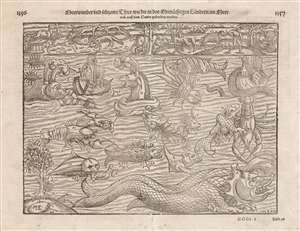
Meerwunder und seltzame Thier wie die in den Mitnåchtigen Låndern im Meer.
sold
- Digital Map Information
- Suitable for large format printing
- Full resolution TIFF file
- ICC color profile embedded
- Delivered instantly via download link
Often euphemistically referred to as Münster's Monsters, this is Sebastian Münster's bestiary of sea serpents and other astonishing monsters, some fictional, some real. The image first appeared in the expanded 1550 editions of Münster's Cosmographia, a work which for more than half a century provided the European literate layperson their best source of information about the world. Most of the beasts here are derived from a 1539 map of Scandinavia by Olaus Magnus. As fanciful as these creatures may appear, many depict actual creatures that Scandinavian sailors and whalemen occasionally encountered. Among the more recognizable beasts are whales identifiable by the spouts from their blowholes; two enormous lobsters (one of which is dragging a hapless sailor into the depths), a sea serpent (possibly an oarfish), the whale fish, and something that might very well be a walrus. There are fictional sea monsters too, including a pig faced sea beast, apparently seen by sailors in 1537, and the Sea Buffalo, something that looks like a cross between a bull and a fish. (more details)