
Jaugeon, Nicolas (sold)

Nicolas Jaugeon (fl. c. 1680 - 1710) was a typographer, mathematician, and engraver active in Paris in the late 17th and early 18th centuries. Jaugeon is best known for the 1692 invention of the typeface Romain du Roi, which is best known today as Times New Roman. The typeface was revolutionary at the time as it abandoned the artistic principles of calligraphy to instead draft each letter on a uniform mathematical platform. The typeface was initially reserved for the French Royal Press, Imprimerie Royale, but was later adopted by others. Jaugeon was also a prominent and active member of the French Academy of Sciences. He cartographic corpus appears limited to a single, but spectacular, map of the work published in 1688. Another Jaugeon, Jacques, also appears to be associated with the development of Romain du Roi, and the two are often conflated as the same individual, suggesting further research into the elusive but important individual is required.
One of the most richly informative cartographic productions ever created.
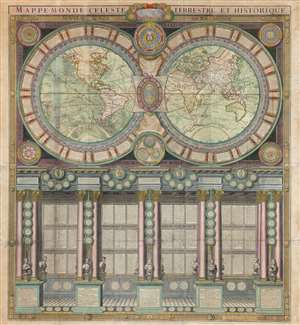
Mappe-Monde Celeste Terrestre et Historique.
sold
- Digital Map Information
- Suitable for large format printing
- DPI: 600
- File Size: 132.49 MB
- File Type: ZIP / TIFF
- ICC color profile embedded
- Delivered instantly via download link
A stunning large format wall map of the world in six panels issued in 1786 by Charles Desnos and Nicolas Jaugeon. Described by map historian Rodney W. Shirley as 'a veritable compendium of a map,' this is one of the most richly informative cartographic productions ever issued. The map consists of a double hemisphere map projection surrounded by no less than 60 Aeoli windheads, astronomical data on constellations, cosmic systems, and other charts - intentionally placing the world in the context of the greater cosmos. Its elegant presentation conveys confidence in the human capacity to describe not only the Earth, but the cosmos itself. The double hemisphere map rests upon Corinthian columns, underscoring the classical foundations of western scientific thought, here augmented by new discovery. The unique, neo-classical motif is carried through to the bottom half of the engraving, where panels of text are set within a portico supported by Corinthian columns. Completing the illusion are a coffered roof and a patterned tile floor. At the base of the columns there busts and accounts of the great explorers, among them Columbus, Magellan, and Vasco de Gama. (more details)