
Varin, Raoul (sold)

Raoul Varin (1865 - 1943) was a French watercolorist active in Europe and the North America in the late 19th and early 20th centuries. Varin exhibited in the Salon of French Artists and received an honorable mention in 1892. He is most famous for his historic Chicago aquatint views, of which he produced some 31 between 1926 and 1932. The collection included historic views drawn from early sources as current views of Chicago as Raoul saw it. Some were engraved by Ernest Byfield, who was the initial publisher of the series. Later, after Byfield went bankrupt, publication was taken over by A. Ackermann and Son's Chicago office. Buoyed by the success of his Chicago series, Varin went on to produce a series of 'Old New York', images, but these did not attain the same level of popularity.
Iconic image of early Chicago.
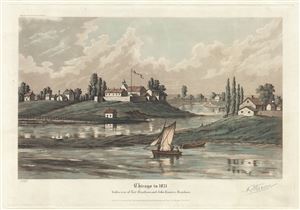
Chicago in 1831 With a view of Fort Dearborn and John Kinzie's Residence.
sold
- Digital Map Information
- Suitable for large format printing
- File Size: 9.54 MB
- File Type: ZIP / TIFF
- ICC color profile embedded
- Delivered instantly via download link
An extremely attractive 1929 hand colored aquatint view of Chicago in 1831 by the French artist Raoul Varin. The view, part of a series completed by Varin between 1927 and 1932, illustrates Fort Dearborn and the surrounding homes. The buildings illustrated, from ... (more details)
The Chicago Water Tower - one of the few buildings to survive the Great Chicago Fire.
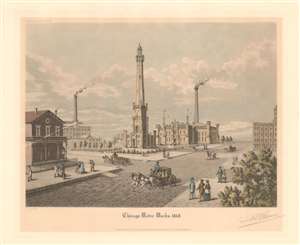
Chicago Water Works 1868.
sold
- Digital Map Information
- Suitable for large format printing
- File Size: 11.79 MB
- File Type: ZIP / TIFF
- ICC color profile embedded
- Delivered instantly via download link
This is a 1929 Raoul Varin aquatint view of the Chicago city waterworks and water tower as it appeared in 1868. Located on modern-day Michigan Avenue (called Pine Street in 1868), the Water Tower and the pump house survived the Great Chicago Fire of October 8-10, 1871. It stands 182.5 feet tall and housed a 138-foot high standpipe while it was operational. When Pine Street was widened in 1918, the plans were revised to give the Water Tower and the Chicago Avenue Pumping Station a featured location. (more details)
Signed view of the Chicago River and the Wells and Clark Street Bridges.
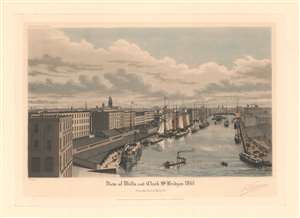
View of Wells and Clark St. Bridges 1861.
sold
- Digital Map Information
- Suitable for large format printing
- File Size: 14.86 MB
- File Type: ZIP / TIFF
- ICC color profile embedded
- Delivered instantly via download link
This is a 1929 Raoul Varin aquatint view of the Wells and Clark Street Bridges across the Chicago River in Chicago, Illinois. Looking west along the Chicago River, the Chicago Tobacco Works and the Western Transportation Company appear in the foreground. Boats line the Chicago River, and the span of the Clark Street Bridge is turned horizontally to allow a boat to pass. The Wells Street Bridge still spans the river and has not yet been swung upward for the boat. The top of the courthouse is visible over the buildings, along with the steeples of several churches. (more details)
A view of the first Rush Street Bridge that was destroyed three years after it opened.
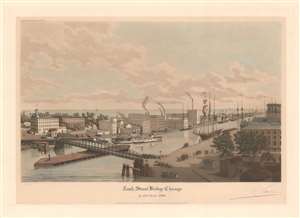
Rush Street Bridge Chicago in the Year 1861.
sold
- Digital Map Information
- Suitable for large format printing
- File Size: 13.09 MB
- File Type: ZIP / TIFF
- ICC color profile embedded
- Delivered instantly via download link
This is a 1929 Raoul Varin aquatint view of the Rush Street Bridge. The bridge occupies the foreground and a large crowd of people gather on the near end of the bridge. Buildings line the far bank, McCormick's Reaper Factory and the sugar refinery both identified. Sailing ships line both banks of the Chicago River and a steamship, name the Comet steams away from the bridge toward Lake Michigan. (more details)
The Magnificent Mile.
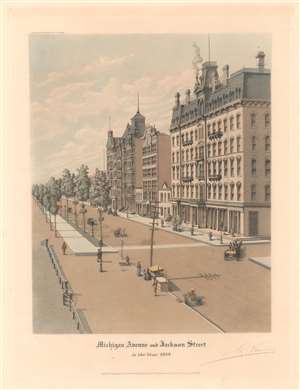
Michigan Avenue and Jackson Street in the Year 1889.
sold
- Digital Map Information
- Suitable for large format printing
- File Size: 12.8 MB
- File Type: ZIP / TIFF
- ICC color profile embedded
- Delivered instantly via download link
This is a 1929 Raoul Varin aquatint view of the Leland Hotel at the corner of Michigan Avenue and Jackson Street, on the Magnificent Mile. Trees line Michigan Avenue and pedestrians walk along the sidewalks. Horse-drawn carriages make their way up and down Michigan Avenue transporting Chicago's elite. The Leland Hotel appears prominently at right. (more details)
Lake Shore Drive (then) 1889 and (now) 1934.
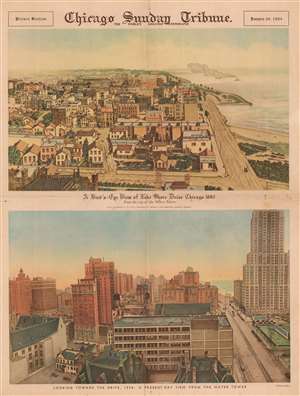
A Bird's-Eye View of Lake Shore Drive Chicago 1883 From the top of the Water Tower. Looking toward the Drive, 1934: A Present-Day View from the Water Tower.
sold
- Digital Map Information
- Suitable for large format printing
- File Size: 22.1 MB
- File Type: ZIP / TIFF
- ICC color profile embedded
- Delivered instantly via download link
This is a 1934 Chicago Sunday Tribune bird's-eye view of Lake Shore Drive in Chicago. The two separate views, presented on a single broadsheet, both look north on Lake Shore Drive from the Water Tower, but at different points in history, 1889 and 1934, respectively. The upper view is an aquatint issued by Raoul Varin in 1889. The bottom view is a photograph taken by the Tribune from the Water Tower in 1934. The differences provide an striking visual summary of Chicago's urban progression during the first few decades of the 20th century. (more details)