
1981 Hunting Geology and Geophysics Arabic Geological Map of Kuwait

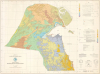
Geological Map of the State of Kuwait / خريطة جيولوجية لدولة الكويت.
Kuwait Becomes a Major Player in the Global Oil Industry.
Kuwait Becomes a Major Player in the Global Oil Industry.
This is a scarce, large-format bilingual geological map of Kuwait, prepared in 1981 by Hunting Geology and Geophysics for the Kuwait Oil Company. It was produced at a time when Kuwait's oil production was undergoing rapid changes, including the creation of the Kuwait Petroleum Corporation (KPC), of which the Kuwait Oil Company became a subsidiary, and expansion into international markets and the securing of vertical integration.A Closer Look
The map covers the mainland of Kuwait along with the Bubyan and Failaka Islands, using color-shading to indicate a variety of sands, gravels, clay, and stone, as explained in the bilingual legends present at right, which also indicate geological era. Lines and other notation are used to indicate geological and international boundaries, fault lines, wadis, elevation (contour lines), roads, depressions, and intertidal and shoaling sand. Developed areas, namely Kuwait City and some nearby coastal settlements, are shaded grey. Additional supplementary information appears at right, including a diagram and explanation of the local grid employed.Historical Context
Upon gaining independence from the United Kingdom in June 1961, Kuwait inherited an oil industry dominated by the Kuwait Oil Company (KOC), a joint venture between British Petroleum and Gulf Oil. However, like other emerging postcolonial states in the region, Kuwait was determined to assert control over its primary resources. This effort began with the formation of the Kuwait National Petroleum Company (KNPC) in 1960 and the Petrochemical Industries Company (PIC) in 1963, which allowed the government to build domestic technical expertise. A major milestone of this era was the 1962 relinquishment agreement, which forced foreign concessionaires to return 60 percent of their unexplored territories to the state, paving the way for independent national exploration and the 1968 opening of the Shuaiba Refinery, the world's first all-hydrogen refinery.The 1970s saw a shift from foreign partnership to total nationalization following the 1973 oil crisis and the subsequent surge in global prices. After an initial 'participation' agreement in 1972 that gave the state a 25 percent stake in KOC, Kuwait moved for a full takeover by December 1975. By 1976, the state held 100 percent ownership of its oil assets, allowing it to cap production to conserve reserves for future generations, a policy that stood in contrast to the high-extraction strategies of foreign firms (who further increased production as they sensed nationalization was in the offing). Thus, the vast revenues generated by the oil industry were funneled directly into the Reserve Fund for Future Generations, established in 1976 to provide long-term fiscal stability. They also financed a comprehensive welfare state, providing citizens with free education, healthcare, and subsidized housing, while transforming the capital of Kuwait City (simply 'Kuwait' الكويت here) into a modern metropolis.
By the early 1980s, Kuwait shifted its focus toward global integration and organizational efficiency. In January 1980, the government established the Kuwait Petroleum Corporation (KPC) as a centralized holding company to manage all aspects of the industry, from upstream exploration to downstream retail. Kuwait became a pioneer among OPEC nations by aggressively expanding into international markets, acquiring the American drilling and engineering giant Santa Fe International in 1981. This strategy continued with the acquisition of refining and retail networks in Europe, laying the groundwork for the 1983 launch of the 'Q8' brand. Thus, by the mid-1980s, Kuwait had successfully established one of the most vertically integrated and professionally managed state oil industries in the world.
Publication History and Census
This map was compiled and drawn by Hunting Geology and Geophysics for the Kuwait Oil Company. It is quite scarce, noted only in the holdings of the Colorado School of Mines, the U.S. Geological Survey Library, and the Library of Congress, with no known market history.Cartographer
Hunting Geology and Geophysics Ltd. (1952 - 1987) was a British surveying firm that specialized in cutting-edge methods of mapping, especially aeromagnetic surveys, and focused on discovering potential reserves of natural resources, especially fossil fuels. It was part of the larger Hunting Group, originally founded in 1874 as a shipping company by Charles Hunting, and later moving into aircraft, surveying, and petroleum. Companies within the Hunting group frequently merged with each other and with outside acquisitions, leading to frequent name changes; in this case, Hunting Aerosurveys (founded 1944) merged with Hunting Geophysics (founded 1952) to form Hunting Surveys in 1960. In 1965, a public company was formed called Hunting Associated Industries Ltd., which included Hunting Surveys (Holdings) Ltd. but not a new entity, Hunting Geology and Geophysics Ltd., which remained part of the privately-owned Hunting Group. In 1987, Hunting Geology and Geophysics Ltd. was closed down in a consolidation process that saw the public company (now Hunting PLC) buy out the Hunting Group, though the Hunting family retains a significant share of the company's stock and one of its members remains Chairman of the Board. Hunting Geophysics, and later Hunting Geology and Geophysics Ltd., made pioneering surveys of Great Britain itself, along with several countries in Central Africa (seeking uranium and other minerals), the Philippines, Ethiopia, and especially countries in the Middle East, where the company conducted critically important surveys that helped to develop the lucrative oil industries of the United Arab Emirates, Qatar, and Kuwait, among others. Further Details...
Condition
Excellent.
References
OCLC 9971094.