
1898 Service des Cartes et Plans Map of Algeria and Muslim World, Muslim Communities

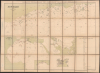
Domaine géographique des confréries religieuses musulmanes.
Sufi Orders and Anti-Colonial Resistance in French Algeria.
- Digital Map Information
- Suitable for large format printing
- Full resolution TIFF file
- ICC color profile embedded
- Delivered instantly via download link
Sufi Orders and Anti-Colonial Resistance in French Algeria.
This is a very large format (40.5 x 53.5 in.) map of Algeria and the Arab World, prepared by the French colonial Gouvernement Général's Service des Cartes et Plans. Charting the distribution of various Muslim confréries (associations, societies, orders, brotherhoods), particularly Sufi tariqas, it provides a glimpse of the great variety of religious devotion throughout the Arab World. At the same time, the map reflects the anxieties of France's colonial administration, which saw such religious associations as a major threat to its rule.A Closer Look
The sheet is divided into three main maps along with a legend and two additional inset maps. The top half of the sheet covers northern Algeria, where the vast majority of the population lives, divided into départements and communes. A map in the bottom-left quadrant covers northern Africa and includes an inset of Cyrenaica, the eastern part of Libya's northern coast. A third map covers Asia and 'European Turkey,' with an inset of Istanbul (Constantinople) below. All five maps record the locations of mother, principal, and ordinary zaouias (zawiyas), structures or institutions associated with Sufi tariqas, several dozen of which are listed with distinctive symbols. On the maps of Algeria and Cyrenaica, the areas of most concern to the French colonial administration in Algeria, the number of followers (adeptes) in each zaouia is recorded.Historical Context
Following the 1830 French invasion of Algiers, Islam served both as the central target of colonial subjugation and the primary framework organizing indigenous resistance. To break native socio-political cohesion, the French administration aggressively targeted Islamic institutions by expropriating habous (waqfs). These religious and charitable endowments historically funded mosques, schools, and public welfare. Colonial authorities demolished hundreds of mosques or repurposed them as barracks, hospitals, and stables. In a deliberate assertion of cultural dominance, authorities converted significant religious sites into Christian places of worship; most notably, the 17th-century Ketchaoua Mosque in Algiers was transformed into the Cathedral of Saint Philippe in 1832.In response to the dismantling of urban institutions and Ottoman administration, religious confréries (Sufi tariqas) emerged as the primary vehicle for anti-colonial resistance across Algeria. Operating through widespread networks of rural lodges and religious centers, orders such as the Qadiriyyah and the Rahmaniyyah mobilized tribal populations, provided social relief, and organized armed rebellions. Emir Abdelkader, a leader of the Qadiriyyah order often seen as the 'founding father' of modern Algeria, invoked Islamic principles to unite disparate tribes into a state-like coalition that resisted French conquest for over a decade. Later, in 1871, the Rahmaniyyah order played a decisive role in organizing the massive Kabyle uprising (Mokrani Revolt) led by Sheikh Mokrani and Lalla Fadhma N'Soumer.
To better understand (and thus suppress) the Sufi tariqas, the French colonial administration sponsored a series of studies by colonial officials who were particularly knowledgeable about the topic, including Edouard de Neveu (Les Khouan [Ikhwan], Ordres Religieux Chez les Musulmans de l'Algérie, 1846), Louis Rinn (Marabouts [descendents of the Prophet and spiritual leaders of the tariqas] et Khouan. Étude sur l'Islam en Algérie , 1884 and Histoire de l'Insurrection de 1871 en Algérie , 1891), and Octave Depont and Xavier Coppolani (Les confréries religieuses musulmanes, 1897). Although the authors, who had lived in Algeria for years and were fluent in Arabic, were indeed experts on the topic, their stated motivation was to strengthen French colonial rule, which precluded a genuine understanding of the anger motivating resistance among such religious associations.
Beyond Algeria, Sufi confréries posed a major obstacle to the broader expansion of French power across North Africa. Transnational orders like the Sanusiyyah and Tijaniyyah utilized trans-Saharan trade routes and regional religious prestige to link Algerian insurgents with supporters in Morocco, Tunisia, and Libya. French military intelligence viewed these brotherhoods with intense suspicion, often characterizing them as conspiratorial networks that threatened imperial stability.
Publication History and Census
This map was prepared by the colonial Gouvernement Général, Service des Cartes et Plans, and published by Adolphe Jourdan in Algiers in 1898. It was reproduced in the book Les confréries religieuses musulmanes by Octave Depont and Xavier Coppolani (two colonial officials familiar with the topic), also published by Jourdan in 1897. However, the present map is an earlier, separately issued printing produced for the French colonial administration in Algeria (almost certainly prepared by Depont and Coppolani), cataloged under this title only at the Bibliothèque Nationale du Royaume du Maroc and the Biblioteca Nacional de España. The map is also cataloged under the title on the cover of the map's wrappers (missing in our example), 'Les confréries religieuses musulmanes. Carte de l'Algérie, l'Afrique, l'Asie et la Turquie d'Europe,' at seven institutions, only two of which (Stanford University and Cornell University) are in North America.Cartographer
Adolphe Dominique Jourdan (August 4, 1846 - August 15, 1916), not to be confused with the contemporary painter of the same name, was a prominent 19th-century French bookseller, printer, and publisher based in Algiers (Alger), Algeria. Active as a publisher from 1870, Jourdan had trained and worked under his uncle, Julien Hippolyte Bastide (1814 - 1871), who had founded a publishing house in Algeria in 1833, which Jourdan inherited upon Bastide's death. Jourdan's works primarily dealt with Algeria and the wider Arab and Muslim worlds, touching on subjects such as archaeology, translation, religious studies, and anthropology (cultures of Algeria). Jourdan also published scholarly journals, especially the long-running Revue africaine for the Société historique algérienne, and official-administrative collections such as Bulletin judiciaire de l'Algérie. In brief, Jourdan was one of the main distributors of information about Algeria and the wider Arab and Muslim worlds in French in the colonial period. Jourdan was also active in local politics and civic life. He married Marie Dermineur. After Jourdan's death, the firm passed to Jules Carbonel (perhaps his own nephew), who had worked for the firm for many years and began publishing under his own name (Imprimerie Carbonel, or, for a short time, as Ancienne maison Bastide-Jourdan) and later as Imprimeries La Typo-Litho et Jules Carbonel, seemingly after acquiring another printer. The firm continued to hold a prominent place among French publishers in Algeria well into the mid-20th century, down to the end of the colonial period, maintaining its areas of specialization (publishing, for example, the Annales de l'Institut d'Études Orientales in the mid-20th century). Further Details...
Condition
Very good. Dissected and mounted on linen. Verso reinforcements to separations in the linen.
References
OCLC 431613984, 929535494, (under alternate title) 38772460, 66076272, 556205603.