
Staehlin, Jacob von (sold)

Jacob von Staehlin (May 9, 1709 - June 25, 1785) was a German-Russian polymath known as an engraver, cartographer, memoirist, full state councilor, and member of the Russian Academy of Sciences. Born in Memmingen, Upper Swwabia, von Staehlin attended the University of Leipzig and, in 1735, was called to St. Petersburg to work for the St. Petersburg Academy. He became a member of the Academy and a professor of 'eloquence and poetry' in 1738 and in 1741 took over the Department of Art at the Academy. He was appointed teacher to the heir to the Russian throne, Peter Fedorovich, in 1742, and after his wedding was named his personal librarian. Staehlin helped with the creation of the First Atlas of the Russian Empire, which was published in 1745. The art department was changed into the Academy of Fine Arts in 1747, and Staehlin was was entrusted with its management, and even developed drawing and engraving programs. Staehlin died in St. Petersburg in 1785.
An updated version of Muller's iconic map of the discoveries of Vitus Bering.
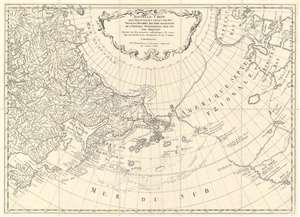
Nouvelle Carte des Decouvertes Faites par des Vaisseaux Russiens aux Cotes Inconnues de l'Amerique Septentrionale avec les Pais Adiacents. Dressée sur des memoires authentiques de ceux Qui ont assisté a ces decouverts, et sur d'autres Connoissances.
sold
- Digital Map Information
- Suitable for large format printing
- DPI: 600
- File Size: 27.6 MB
- File Type: ZIP / TIFF
- ICC color profile embedded
- Delivered instantly via download link
This is a 1773 Jacob von Staehlin map of the Pacific Northwest, the Arctic, and Siberia, which has been updated from Fredrick Muller's iconic 1754 map of the same region illustrating the findings of Vitus Bering's Great Northern Expedition. The map depicts from eastern Novaya Zemlya (Nowaja Semlja) to Hudson Bay and from the Arctic Ocean to California and Honshu, Japan. Von Staehlin's map includes a depiction of an archipelago in the place of Muller's namesake peninsula, which, although inaccurate, is closer to the real geography of the region. The Aleutians are illustrated as a string of islands emitting from a larger island which, although not connected to North America, certainly appears to be a proto-Alaska. (more details)