
Sweynheim, Konrad (sold)

Konrad Sweynheim (died 1477) was a German printer and engraver. Nothing is known of his early years. It is believed that he worked with Johannes Gutenberg between 1461 and 1464 and was instrumental in the early development of printing in Europe. He, along with Arnold Pannartz, is credited with having introduced Gutenberg's invention, the mechanical movable-type printing press, to Italy. The two printers first worked in Subiaco, printing a Donatus which has not survived. The earliest surviving book printed in Italy by them was Cicero's De oratore, printed in 1465. During the course of their early works, they abandoned the German typefaces they had worked with, becoming the first to print in Roman lettering. Sweynheim and Pannartz settled in Rome in 1467, working prolifically - but unsuccessfully: nobody wanted to buy their books, until they began receiving Church assistance in the early 1470s. At this point the two parted ways, after which Sweynheym took up copperplate engraving. He engraved the maps for the superb Rome Ptolemy but did not live to see the work through to its publication. This was completed by his fellow German printer Arnold Buckinck. The Rome Ptolemy was the second to be published containing maps engraved in copper, preceded only by the Bologne Ptolemy of 1477 (though it is probable that the copperplates were completed prior to those of the 1477.) An interesting idiosyncrasy of Sweynheim's work was that the text on the maps was not engraved by hand but stamped into the printing plate with specially made letters, the oldest known use of this technique for this purpose.
Earliest Acquirable Printed Map of Arabia.
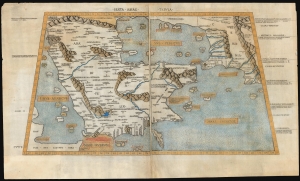
Sexta Asiae Tabula.
sold
- Digital Map Information
- Suitable for large format printing
- Full resolution TIFF file
- ICC color profile embedded
- Delivered instantly via download link
A foundational work of Renaissance cartography: this is the first acquirable printed map of the Arabian Peninsula. Appearing in the Rome edition of Ptolemy, in its 1478 printing, it is preceded only by the unacquirable 1477 Bologna Ptolemy. Ptolemy's 2nd-century innovation of representing the three-dimensional world on a grided mathematical projection provided the basis of all modern cartography. Of all the early printed versions of Ptolemy's maps, those produced for the Rome edition are considered the finest until Mercator's 1578 edition. The present example is embellished with attractive old hand color. (more details)
Finest Early Copperplate Map of the World.
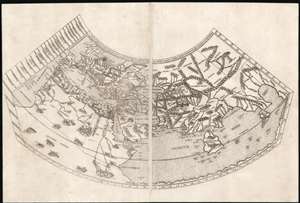
Untitled Map of the World.
sold
- Digital Map Information
- Suitable for large format printing
- Full resolution TIFF file
- ICC color profile embedded
- Delivered instantly via download link
A foundational work of Renaissance cartography: this is the first, acquirable, printed map attempting a measured representation of the known world. The world map from the Rome edition of Ptolemy, in its 1478 printing it is preceded only by the unacquirable 1477 Bologna Ptolemy, the Medieval mappamundi of the Rudimentum Novitorum and the schematic 1472 Isidorus T-O map. Ptolemy's second-century innovation in representing the three-dimensional world with a grid on a projection, using mathematical methods to produce an accurate map, provided the basis of all modern cartography. Of all the early, printed versions of Ptolemy's maps, those produced for the Rome edition are considered to be the finest until Mercator's 1578 edition of the work. (more details)