
Tharp, Marie (sold)
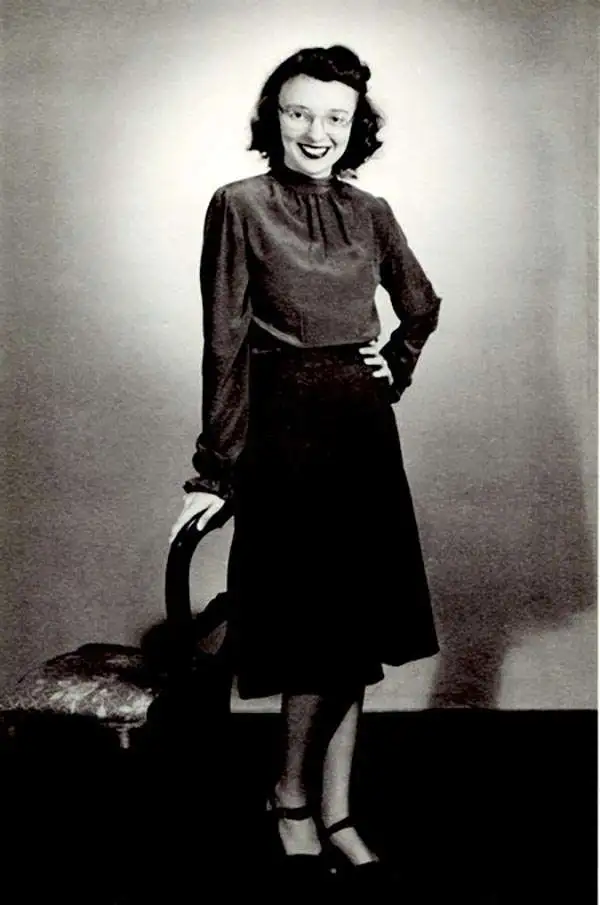
Marie Tharp (July 30, 1920 - August 23, 2006) was a prominent American oceanographic cartographer and geologist - recognized as a pioneer in the male-dominated world of geology. Tharp was born in Ypsilanti, Michigan. She was introduced to mapmaking through her father, who was a surveyor for the U.S. Department of Agriculture. She studied at the University of Ohio, earning Music and English degrees. During World War II, she earned a Masters in Geology at the University of Michigan, graduating in 1944, and later a second bachelor's in mathematics (1948). She first worked as a research assistant at Lamont Geological Laboratory in Columbia University in New York. Tharp was Bruce Charles Heezen's (1924 - 1977) assistant while he was a graduate student, and he gave her the task of drafting seafloor profiles. Her discoveries of the Mid-Atlantic Rift and the Mid-Atlantic Ridge, while initially dismissed because of her gender, eventually led to a life-long collaboration with Heezen. Today, Tharp is best known for her decades long project to map the ocean floors with sonar imaging. This revolutionary work contributed to our modern understanding undersea geography, plate tectonics, and continental drift. Ironically, women at that time were unwelcome on scientific marine voyages, so while she mapped the oceans, she never personally went to sea. Her published maps include the North Atlantic (1957), South Atlantic (1961), Indian Ocean (1964), and the world (1977). She remained at Columbia University until retiring in 1983.
A triumph for geology and for women in science.
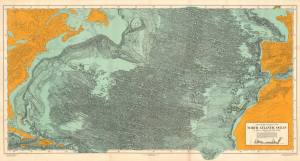
A visually striking and scientifically significant 1968 Marie Tharp and Bruce C. Heezen physiographic map of the North Atlantic detailing the submarine topography. It is a revolutionary work. The massive map combines the genuine scientific work of interpreting and compiling thousands of sonar images with accomplished artistry. This work represents the culmination of over 30 years of collaboration between Tharp and Heezen, led by Tharp, to produce a meticulous sonar map of the ocean's floors. Among other accomplishments, their work led to the discovery of the Mid-Atlantic Rift, the Mid-Atlantic Ridge (as depicted here), and redefined both submarine geology and our understanding of plate tectonics. Moreover, Tharp's work was pioneering in elevating the role of women in the sciences. (more details)
Revolutionary mapping Sub-Oceanic Topography.
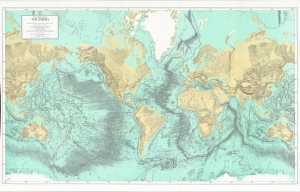
An impressive, large-format 1975 physiographic map of the Earth drawn by William Chesser. Although crude by comparison, Chesser's map is based on the revolutionary mapping of sub-oceanic topography by Marie Tharp and Bruce C. Heezen (credited in title), but predated the 1977 official cartographic release of their work. (more details)
A triumph for geology and women in science.
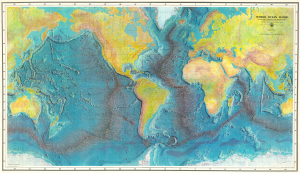
The visually striking and scientifically significant 1977 Marie Tharp and Bruce C. Heezen physiographic map of the world detailing the oceans' floors. The map offers a striking axonometric view of the terrain throughout, with the focus being the seabed. A revolutionary work, it combines genuine scientific work of interpreting and compiling thousands of sonar images, with the exceptional artistry of Heinrich C. Berann. It is the largest map to emerge from the Tharp-Heezen collaboration. (more details)
A modern geological triumph!
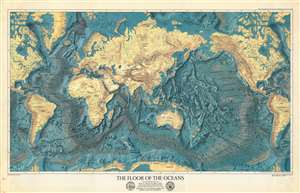
A visually striking and scientifically significant 1977 Marie Tharp and Bruce C. Heezen physiographic map of the world detailing the oceans' floors. The map offers a striking axonometric view of the terrain throughout, with the focus being the seabed. A revolutionary work, it combines genuine scientific work of interpreting and compiling thousands of sonar images, with the exceptional artistry of Tanguy de Rémur. (more details)