
Parker, Ely Samuel (sold)
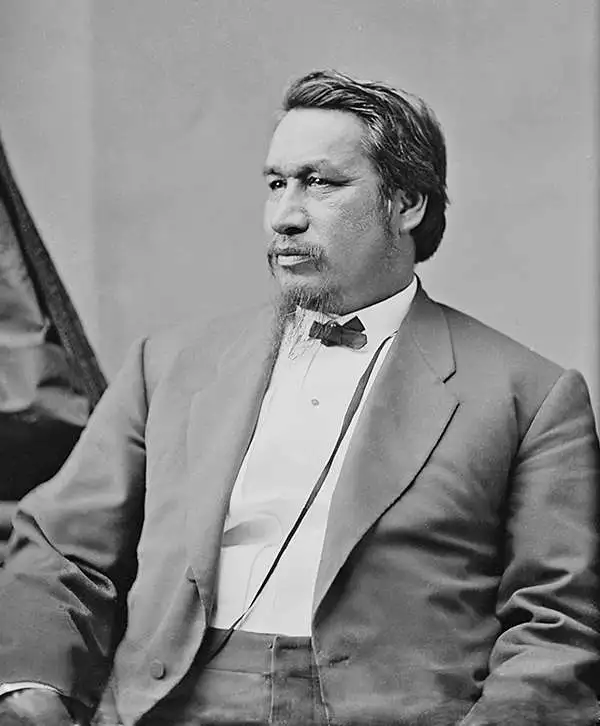
Ely Samuel Parker (1828 – August 31, 1895), born Hasanoanda, later known as Donehogawa, was a Seneca U.S. Army officer, engineer, and tribal diplomat. Born on the Tonawanda Reservation in Indian Falls, New York to a prominent Christian Seneca family, his family frequently interacted with white American scholars interested in the history of the Native Americans of the region, including Lewis Henry Morgan. Like Morgan, Parker trained as a lawyer but later attended the Rensselaer Polytechnic Institute and studied civil engineering. During the 1850s, he helped to upgrade the Erie Canal and also acted as an interpreter for treaty negotiations between the U.S. government and the Seneca nation. Around this time, he met Ulysses S. Grant, who later took Parker on as a member of his staff during the Civil War, a role in which he helped to draft the documents of surrender at Appomattox Courthouse. When Grant became president in 1869, he nominated Parker as Commissioner of Indian Affairs, where Parker pursued a policy of negotiation in place of military actions with Native American tribes in the American West. However, this proved difficult to enact in practice. The guiding philosophy, shared by Parker, was that Native Americans should be moved to reservations and (forcibly) assimilated into American society, which many were not willing to do, especially once they discovered the barren lands that had been assigned to them. When resistance turned to violence, Grant was pressured into using military force in response. Parker himself became the object of corruption charges lobbed by competing 'experts' on Indian affairs who coveted his job, and his authority was curtailed as a result. He resigned in protest in 1871.
New York under the Iroquois.
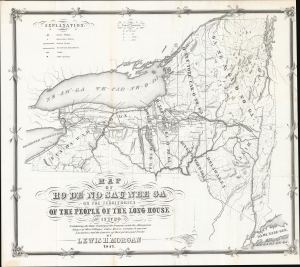
Map of Ho-De'-No-Sau-Nee-Ga or the Territories of the People of the Long House in 1720. Exhibiting the Home Country of the Iroquois with the Aboriginal Names of their Villages, Lakes, River, Streams and Ancient Localities, and the courses of their principal Trails.
sold
- Digital Map Information
- Suitable for large format printing
- DPI: 600
- File Size: 462.83 MB
- File Type: ZIP / TIFF
- ICC color profile embedded
- Delivered instantly via download link
This is the rare 1851 first edition of 'Father of American Anthropology' Lewis Henry Morgan and Seneca Sachem Ely S. Parker's map of New York as it existed under the Iroquois League c. 1720. This novel work is one of the few maps published in the 19th century to directly detail American Indian lands, routes of travel, and language. It is considered the first scientific representation of an American Indian Tribe on a map. (more details)
New York under the Iroquois.

Map of Ho-De'-No-Sau-Nee-Ga or the Territories of the People of the Long House in 1720. Exhibiting the Home Country of the Iroquois with the Aboriginal Names of their Villages, Lakes, River, Streams and Ancient Localities, and the courses of their principal Trails.
sold
- Digital Map Information
- Suitable for large format printing
- DPI: 600
- File Size: 478.64 MB
- File Type: ZIP / TIFF
- ICC color profile embedded
- Delivered instantly via download link
This is the rare 1851 first edition of 'Father of American Anthropology' Lewis Henry Morgan and Seneca Sachem Ely S. Parker's map of New York as it existed under the Iroquois League c. 1720. This novel work is one of the few maps published in the 19th century to directly detail American Indian lands, routes of travel, and language. It is considered the first scientific representation of an American Indian Tribe on a map. (more details)
Unique encyclopedic record of Native American toponomy.
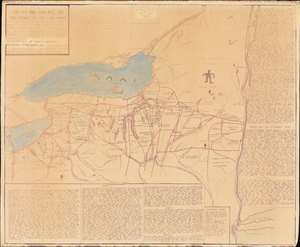
An extraordinary 1962 diazotype map by Eber Russell displaying the Native American (Iroquoian) toponymy for settlements, waterways, and other features in upstate New York and portions of Pennsylvania. One of just 4 surviving examples, this map is the product of more than 50 years of research, and an invaluable resource for understanding the pre-colonial Native American presence in New York. The present work was compiled by Eber Russell, who substantially reworked a 19th century map by Lewis Henry Morgan and Adirondack specialist Ely Samuel Parker, two of the most prominent experts on Native American cultures in their time. Compared to its predecessor, Russell's map is a significantly different work on all levels: substantially larger, more focused, more toponymy, and heavily annotated. (more details)